Scaling AI Data Centers: Solving for 100kW Rack Densities
Key Takeaways
The rapid expansion of artificial intelligence (AI) applications is fundamentally altering the physical requirements of the modern AI data center. This shift is not a gradual evolution. As GPU clusters push power densities beyond 100kW per rack, traditional air cooling reaches a hard physical limit where the volume of air required to dissipate heat exceeds the capacity of standard floor tiles and fans. Infrastructure directors now face a difficult choice: limit the density of their compute clusters or overhaul their thermal architecture to accommodate liquid-based systems.
How Does AI Impact Modern Data Center Operations?
AI workloads require unprecedented power density, often exceeding 100kW per rack, which pushes traditional air-cooled infrastructure toward its physical operating limits. To maintain performance, operators are shifting to liquid cooling technologies that provide superior thermal conductivity. This transition allows for higher compute density within a smaller physical footprint while meeting strict energy efficiency mandates.
Transitioning to Data Center Liquid Cooling
As high-density compute pushes traditional air-cooled infrastructure beyond its physical limits, the industry is pivoting toward liquid cooling to gain superior thermal conductivity and volumetric heat capacity. For most OEMs, the integration of Direct-to-Chip (DTC) cold plates represents the primary entry point for managing these escalating Thermal Design Power (TDP) requirements.
Direct-to-chip cooling utilizes cold plates placed in direct contact with high-heat primary components like processors and accelerators. This method captures and removes heat directly at the source, drastically reducing the demand on facility-level air conditioning.
While this method offers a familiar path for retrofitting existing sites, the industry is increasingly evaluating immersion cooling for greenfield projects. An immersion cooling data center involves fully submerging server hardware in a thermally conductive, dielectric fluid. This approach eliminates the need for complex internal heat sinks and allows for even higher density rack cooling configurations.
The Role of the Coolant Distribution Unit
Coolant Distribution Unit (CDU) systems act as the heart of any liquid-cooled infrastructure. A CDU manages the exchange of heat between the secondary liquid loop inside the IT equipment and the primary facility water loop. These units regulate pressure, filtration and fluid temperature to ensure the stability of the entire thermal circuit.
To understand the CDU, consider the physiology of an Olympic athlete. If the GPU clusters are the muscles generating intense heat during a sprint, the CDU is the heart. It doesn’t just pump fluid; it regulates pressure and temperature to ensure the system doesn’t overheat and fail at the moment of peak exertion. Without this precise regulation, the most powerful hardware in the world is essentially a sprinter without a circulatory system.
Reliability in CDU design remains paramount because a single point of failure can impact an entire row of high-performance compute nodes. Maximizing reliability in these systems requires translating complex fluid dynamics into repeatable manufacturing processes. By collaborating on thermal flow analysis during the industrialization phase, Plexus helps OEMs predict how these units will perform under the extreme heat loads of modern AI workloads. Simulating these variables early allows for the identification of potential failures in the chassis and enclosure geometry before a physical prototype is built.
Optimizing Data Center Power Usage Efficiency
Power Usage Efficiency (PUE) is the industry standard benchmark used for quantifying the ratio between total facility energy consumption, which includes overheads such as cooling and lighting, and the actual load delivered to the computing equipment. While traditional facilities often operate with higher PUE levels, a liquid-cooled AI data center can target significantly lower ratios because liquid cooling can be up to 40 percent more efficient than traditional air systems. This improvement in data center efficiency is no longer just a financial goal.
Regulatory frameworks like the EU Energy Efficiency Directive (EED) and the Climate Neutral Data Centre Pact (CNDCP) mandate strict performance standards. Data center operators in the European Union with an installed capacity of 500kW or more must now provide detailed disclosures on their energy consumption and PUE. Strategy dictates that OEMs should design their systems for maximum energy efficiency, as procurement leaders increasingly prioritize infrastructure that lowers the total cost of ownership while meeting regional environmental mandates.
Scaling Through the Modular Data Center Market
The modular data center provides a solution for the rapid deployment of AI-ready capacity. Rather than waiting years for traditional brick-and-mortar construction, operators are turning to prefabricated modules that can be shipped and commissioned in a fraction of the time. The modular data center market has expanded as companies seek to place high-density compute closer to power sources or edge locations.
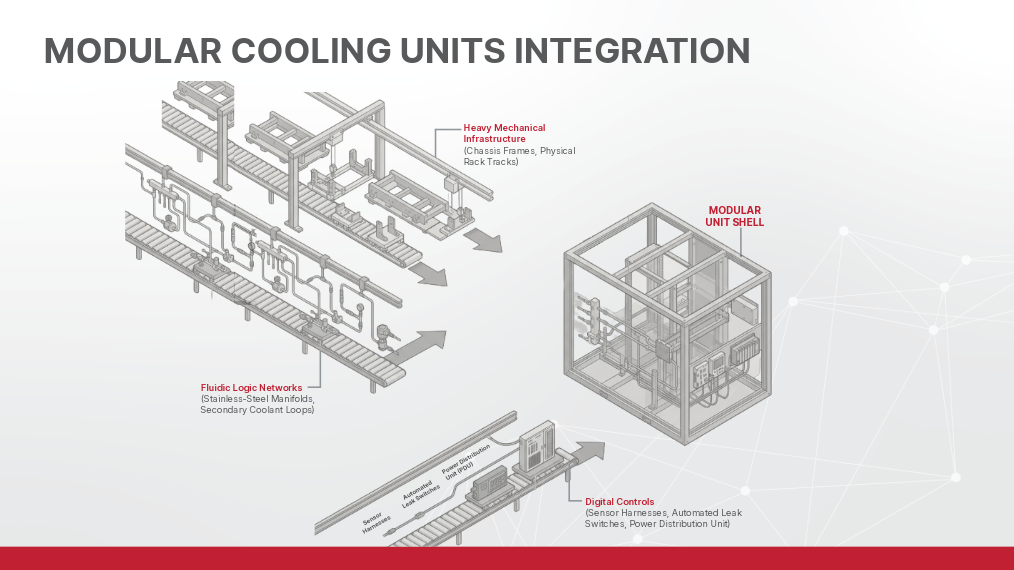
Industrializing these modular units requires a sophisticated assembly process known as a box build. This involves the complex integration of mechanical structures, electronic control systems and liquid circuits into a single, functional unit. For both OEMs and electronic manufacturing services (EMS) providers, an additional challenge lies in managing the global supply chain for specialized components.
Plexus manages this complexity by providing the design, engineering, manufacturing and aftermarket solutions infrastructure needed to scale these modular solutions globally. This allows OEM engineering teams to focus their specialized talent on core hardware and software innovation while leveraging a partner’s localized production and integration expertise for the physical build.
By delivering the complete integration of modular cooling units in a box build, Plexus combines mechanical components, electronics and liquid circuits into a ready-to-deploy unit. This level of industrial integration can shorten development cycles and deliver the agile scale that enables manufacturers to reach the market in months rather than years.
The Anti-Competitor Model: Protecting Your Intellectual Property (IP)
A growing trend in data center infrastructure is the emergence of Tier 1 Electronic Manufacturing Services (EMS) providers developing proprietary cooling products. This creates a conflict of interest because the manufacturing partner becomes a competitor to its own customer. Such conflicts slow innovation and put customer IP at risk.
Operating in the AI infrastructure market without a neutral partner is like a Formula 1 team being forced to buy their engines from their direct rival. You are perpetually at risk of receiving second-tier technology while your competitor prioritizes their own car. Plexus acts as a specialized extension of your engine room, providing the industrial horsepower to scale your technology under your own brand, ensuring your innovations remain the sole focus of the partnership.
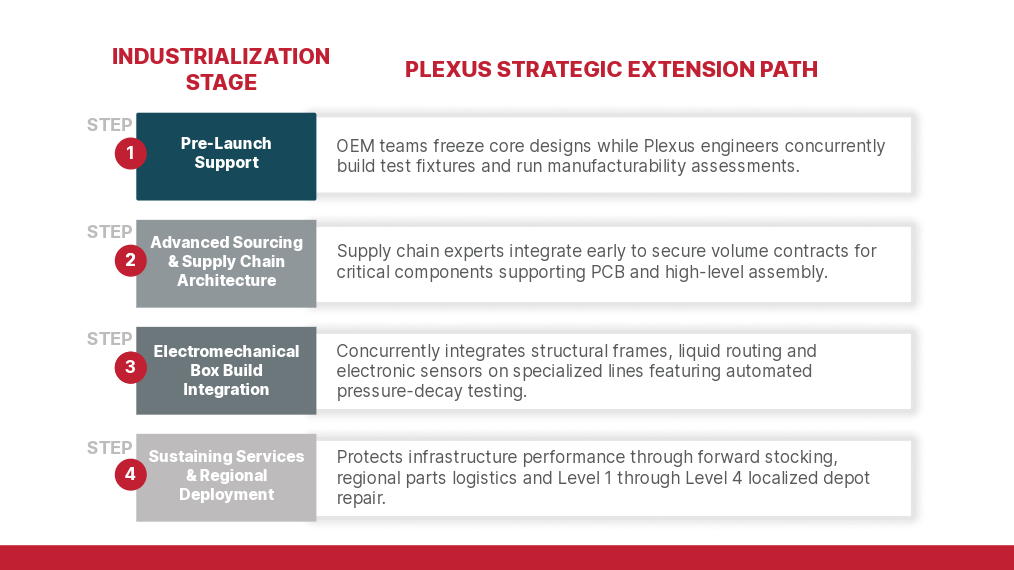
In a high-stakes race where throughput and uptime are critical, traditional hiring cannot bridge the talent gap fast enough. We utilize a strategic extension model, where Plexus functions as a seamless part of your own engineering team. This allows you to retain your core IP while we provide the technical depth to execute complex, system-level work. As a trusted partner, Plexus provides manufacturing scale without the conflict of proprietary product lines. This neutrality is essential for organizations that must bring unique technology to market in months rather than years to meet the 100GW+ global demand for AI infrastructure.
Sustainable Operations and Lifecycle Management
Achieving long-term data center energy efficiency requires a strategy that extends beyond initial deployment. Sustaining services and aftermarket support are critical for maintaining the performance of liquid-cooled systems over their multi-year lifespan. This includes the maintenance of units like CDUs, as well as parts management, forward stocking and logistics.
An effective life cycle strategy also addresses the circular economy. Transitioning from a linear take-make-dispose model to circular manufacturing helps mitigate the risks of volatile raw material markets and rising waste volumes. Plexus integrates these sustainability principles into the product life cycle, from initial design to eventual repair and refurbishment. This support ensures infrastructure remains operational and compliant with global regulations.
Engineering Precision for Giga-Scale Demand
The transition from megawatts to gigawatts of compute power requires a level of industrial coordination that demands significant resources. As 100kW+ rack densities become the standard, the margin for error in thermal management vanishes. Success requires a partner that provides the industrial engineering bandwidth and Design for Excellence (DFX) expertise needed to bridge the gap between a technical concept and a high-volume, global product.
Transitioning from a successful low-volume prototype to the industrial scale required to meet global demand introduces systemic risks that are best addressed through early and simultaneous integration of engineering and manufacturing disciplines.
By offloading the complexities of global sourcing, regulatory compliance and modular integration to Plexus, infrastructure leaders can accelerate their time-to-market. The goal is to reach the market in months rather than years. This speed is the decisive factor in capturing the opportunities presented by the AI boom.
Now that energy directives are being implemented, the focus remains on how compute power is cooled and scaled efficiently. A partnership with Plexus can serve as a vital bridge for technology innovators looking to scale the next generation of global infrastructure.
Contact Our Team
Contact the Plexus team to discuss scaling your unique cooling IP.