Key Takeaways
What is the pure play advantage in European contract manufacturing?
Pure play contract manufacturing in Europe refers to an operational model where an electronics manufacturing services (EMS) partner operates strictly as a service provider. In this model, the partner produces no proprietary product lines that could compete with its original equipment manufacturer customers’ own products. Many electronics manufacturing services companies build their own products alongside customer projects. When an original equipment manufacturer (OEM) partners with a provider that produces competing technology, significant operational and legal exposure arises. Trade secrets and core IP face exposure to internal leakage or factory floor prioritisation conflicts.
Partnering with an EMS provider that owns competing product lines is like hiring a contractor to build your dream home while they’re constructing an identical house next door for themselves. You wouldn’t share your architectural blueprints with a direct competitor, so why hand your core IP to a manufacturing partner building rival platforms?
A pure play contract manufacturing strategy removes these structural risks completely. As a result, engineering talent and production capacity remain focused entirely on customer success. This structural alignment guarantees strict IP protection across high-reliability sectors, including aerospace and medical technology.
Establishing an uncompromised service relationship provides long-term stability for complex electronics. OEMs retain full ownership of their technology throughout the product lifecycle. Contract manufacturing built on pure play principles forms a transparent foundation for high-reliability hardware assembly.
How does supply chain localization in Europe mitigate regional risks?
Using a localization supply chain strategy in Europe mitigates regional risk. It shortens transit distances while shielding operations from trade tariffs and European Union regulatory friction.
Global electronics production networks remain vulnerable to international trade friction alongside long-distance freight delays. Relying on single-region sourcing across Asia creates lead-time uncertainty for European end markets. Moving to a nearshore model helps leaders absorb supply shocks and maintain steady production.
Localizing assembly within European borders simplifies compliance with evolving legal frameworks. Directives such as the European Union Energy Efficiency Directive (EED) require precise reporting on energy usage and carbon footprint for high-density hardware. Sourcing components and building assemblies within the region helps OEMs meet strict environmental standards while reducing Scope 3 logistics emissions.
|
Operational Metric |
Offshore Sourcing Model (Asia) |
Nearshore European Footprint |
|
Transit Lead Times |
Long-distance maritime shipping vulnerable to port congestion |
Shortened regional freight routes for rapid turnaround |
|
Tariff & Trade Exposure |
Exposure to shifting international trade tariffs |
Insulated within European regional trade agreements |
|
Regulatory Compliance |
Complex multi-jurisdictional reporting for EU directives |
Direct alignment with EU Energy Efficiency Directive (EED) and Scope 3 targets |
|
Inventory Buffer Requirements |
High safety-stock inventory required to offset transit volatility |
Reduced working capital needs due to predictable regional delivery |
Why choose UK electronic manufacturers and facilities in Eastern Europe?
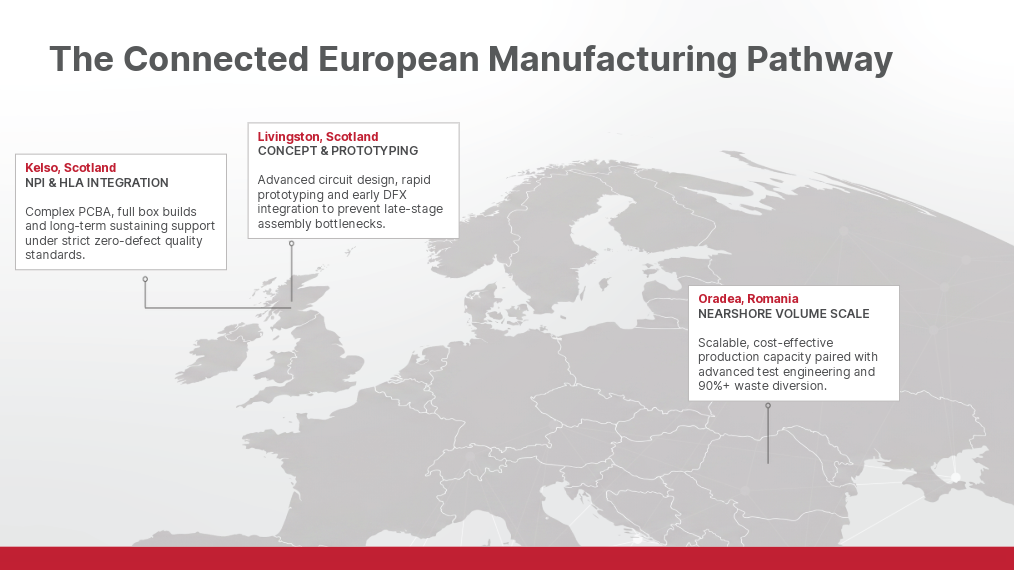
Combining UK electronic manufacturers in engineering design and rapid prototyping with Eastern European volume assembly provides flexible regional production across the entire product lifecycle.
A dual-region European footprint offers strategic flexibility when scaling complex electronic hardware. Splitting development between regional hubs allows engineering teams to refine complex circuit designs and validate early concepts to prevent late-stage assembly bottlenecks.
Transitioning a design from initial validation into full-rate manufacturing requires a clear bridge between design and production. By embedding a Product Development Sourcing Manager (PDSM) early in the New Product Introduction (NPI) phase, technical teams can align bill-of-materials strategy directly with dedicated regional manufacturing sites.
This ensures that advanced printed circuit board assembly (PCBA), high-level box builds and long-term sustaining support are integrated seamlessly. As an added advantage, setting up nearshore manufacturing networks reduces Scope 3 freight emissions and aligns directly with modern corporate sustainability mandates.
When scaling for volume, Eastern European manufacturing hubs offer an optimal balance of technical capability and cost efficiency. Combining high-volume assembly capacity with advanced test engineering allows complex platforms to ramp quickly while maintaining strict quality standards.
Modern nearshore facilities routinely achieve upwards of 90 percent waste diversion through active recycling and energy recovery initiatives. Linking UK design and prototyping expertise with Eastern European volume assembly ultimately provides global OEMs with a secure, highly scalable regional footprint.
How do APQP and DFX de-risk development?
Advanced Product Quality Planning (APQP) and Design for Excellence (DFX) help OEMs spot build issues and part obsolescence before full production begins during new product introduction.
Executing new product launches benefits from structured quality methodologies. APQP provides a standardised framework that coordinates design reviews, quality metrics, approvals and risk management throughout the product lifecycle. Applying APQP protocols aligns engineering teams, supply chain specialists and quality directors around clear project milestones.
Integrating DFX reviews during early product strategy optimizes hardware for production floor efficiency. DFX analysis evaluates PCBA design and high-level assembly (HLA) tolerances. Early reviews verify that board layouts contain adequate access points for In-Circuit Testing (ICT) and Automated Optical Inspection (AOI).
- APQP: Standardises quality workflows and risk management throughout the product life cycle.
- DFX: Optimises PCBA layouts, test point access and mechanical tolerances prior to volume tooling.
- Technology Readiness Level (TRL) Assessments: Provides objective hardware maturity metrics at TRL 3 or TRL 4 to eliminate late-stage redesign cycles.
- Predictive Analytics (DRIVE and ALARM): Monitors component life cycle health in real time to resolve obsolescence and single-source dependencies.
How can executive leaders initiate supply chain localization with Plexus?
Executive leaders can initiate supply chain localization by engaging an EMS partner early in the strategy phase to evaluate bill-of-materials (BOM) health and map a clear regional transition pathway.
Initiating a regional manufacturing transition starts with evaluating the health of the existing BOMs. Supply chain specialists analyze component lead times, single-source dependencies and regional tariff impacts to identify immediate vulnerabilities. Early supply chain engagement establishes preferred supplier relationships that optimize material costs and lead times.
Dedicated transition managers guide the transfer of hardware programs into European facilities. Using standardized project management tools, transition leaders coordinate technical transfers and regulatory compliance without interrupting ongoing supply. This structured transition management approach minimizes financial and operational risks during regional relocation.
Partnering with an established pure play contract manufacturer provides immediate access to certified European facilities. This Infrastructure supports:
- ISO 13485 Certification: Guarantees quality management compliance for medical and life science hardware.
- AS9100 Certification: Ensures aerospace-grade quality control and material traceability
- ISO 9001 Alignment: Standardizes operational excellence across high-reliability industrial sectors
Ready to de-risk your European supply chain and protect your intellectual property?
Connect with the Plexus team today to schedule a consultative BOM health audit and explore how our pure play European design and manufacturing network can accelerate your product strategy.