Solution Spotlight
Customer
Solutions
- Manufacturing
Product
Markets
- Industrial
For over a decade, Plexus has served as a strategic partner to a Global Energy Leader, evolving from a specialized provider into a key contributor supporting it to scale and fulfil the increasing demand from its customers. Since 2017, the partnership has flourished, with Plexus scaling its operations to support more than 1,400% revenue growth over a ten-year horizon.
Central to our collaboration is providing the advanced production capabilities our customer requires to build the latest iteration of their fully digitalized complex computing systems. These units serve as the primary control interface for advanced, large-scale power conversion and grid stability platforms. Manufactured at our Oradea, Romania facility, this next-generation architecture enables utilities to manage complex energy flows and stabilize modern grids during fault conditions, particularly for critical offshore infrastructure.
The Challenge: Beyond Standard Industrial Assembly
The global transition toward renewable energy requires sophisticated grid control systems characterized by absolute determinism and high fault tolerance. Our customer required the precise production of advanced computing units capable of executing high-speed protection algorithms to ensure real-time grid reliability.
As these units manage gigawatts of power across thousands of miles, the process needed to shift from standard industrial assembly toward the precision required for aerospace production. The core manufacturing challenges identified by our Oradea technical teams include:
- Integration Complexity: Multi-OS architectures necessitated precise cross-platform synchronization, as even micro-latency could compromise system determinism.
- The Fiber-Optic Shift: Transitioning from copper to fiber optics eliminated 80% of hard-wired connections, significantly reducing electromagnetic interference (EMI) and improving overall substation safety. However, this shifted the manufacturing burden to a zero-tolerance environment for contamination. Even a microscopic dust particle during the assembly phase can lead to signal attenuation, which is unacceptable in a system utilizing high-speed IEC 61850 process bus protocols and Parallel Redundancy Protocol (PRP) for zero-loss data transfers.
- High-Density Modular Packaging: A 50% reduction in physical footprint created significant hurdles in thermal management. Densely packed processors in the new product generated intense heat, requiring the high-precision placement of heat sinks and customized cooling channels to prevent localized hot spots.
- Component Precision: Utilizing avionics-grade hardware (COTS+) required leveraging a limited pool of certified suppliers and rigorous incoming quality control (IQC) to prevent sub-standard components from entering the stream.
The Solution: Technical Excellence in Execution
Plexus implemented a tailored manufacturing strategy that integrates engineering expertise with advanced production resources to provide a seamless path from development to deployment.
Manufacturing Efficiency: Line Balancing for Complex HLA
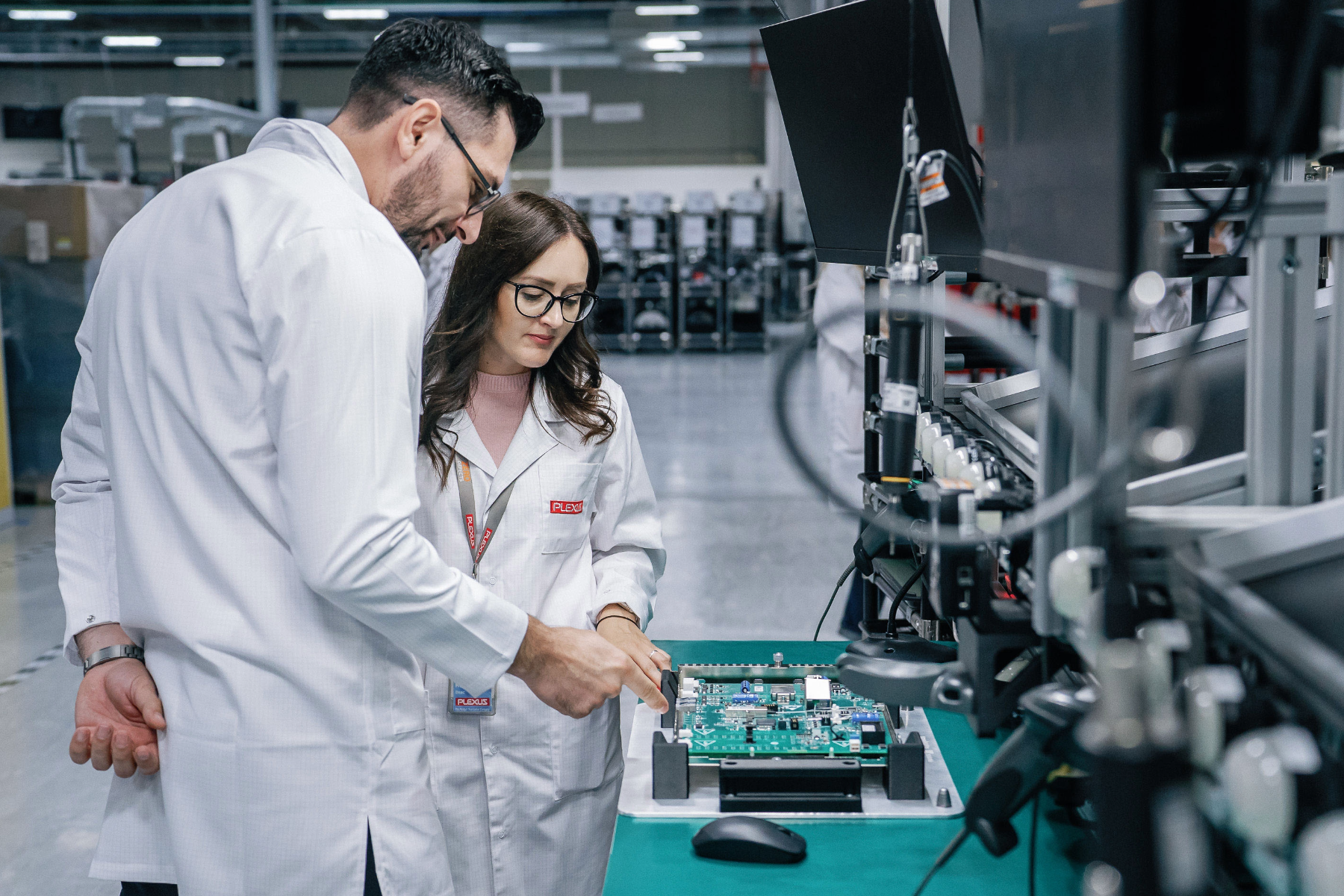
To accommodate the specialized demand for these complex computing systems, the Oradea site implemented a flexible high level assembly (HLA) line. This layout allows for rapid reconfiguration and dedicated stations that ensure high-touch quality for low-volume, high-value products. Multi-disciplinary, expert technical teams oversee the configuration, wiring and validation of these modules, balancing the line layout to optimize material flow and guarantee integrated system performance across diverse platforms.
Advanced Testing and Digital Twins
Because these units control critical infrastructure, every assembly undergoes comprehensive product reliability testing. We verify electrical integrity and hardware functional performance through a layered inspection safety net, including non-destructive 3D X-ray inspection of complex PCBs.
To manage hardware to software interoperability on units utilizing high-speed digital signal processors (DSP) and complex field-programmable gate array (FPGA) logic, factory acceptance tests (FAT) are conducted against a synchronized digital twin simulation. Every unit is tested directly against this digital clone to ensure the modular code interacts perfectly with the physical I/O before shipping to the UK for deployment.

The Results: Scalable Stability
The long-standing partnership has resulted in quantifiable gains for the customer’s operational scale and the reliability of the global energy grid:
- Proven Scalability: Over a 10-year tenure, the relationship has scaled by more than 15x in revenue, demonstrating Plexus’ capacity to scale alongside our customer’s long-term product lifecycles.
- Proactive Continuous Improvement: This growth is anchored by an active, on-site partnership at our Oradea facility. Rather than working in isolation, our manufacturing teams and the customer regularly conduct joint continuous improvement activities directly on the production floor, collaborating transparently to optimize layout configurations and implement fast adjustments.
- EMI/EMC Compliance: By utilizing specialized gaskets and high-precision shielding, Plexus ensures cabinets meet stringent IEC 61850-3 standards despite having 10 times the computing power in half the space.
- Lifecycle Management: Power grids require asset longevity of 25 to 40 years. To support a product designed for line replaceable units (LRU), Plexus provided proactive component engineering and life-of-type sourcing strategies.
- Zero-Defect Mentality: By adhering to stringent certifications such as AS9100 and ISO 9001, Plexus ensures that these systems meet the highest benchmarks for critical infrastructure protection, establishing a solid operational baseline for long-term sustaining services.
Accelerating your path to full-scale production requires a partner with deep mechatronic expertise and a global network of certified facilities. Let Plexus help you optimize your hardware layout, secure volatile silicon lifecycles and scale your volume production seamlessly.